Terminal-inspired File Explorer

tfx
Hands on the keys.
Eyes on your files.

The speed of a terminal with the clarity of a desktop app. tfx is keyboard-first when you want to move fast, and mouse-friendly when direct manipulation feels right.

  • macOS
  • Windows
  • Linux
  • Keyboard first
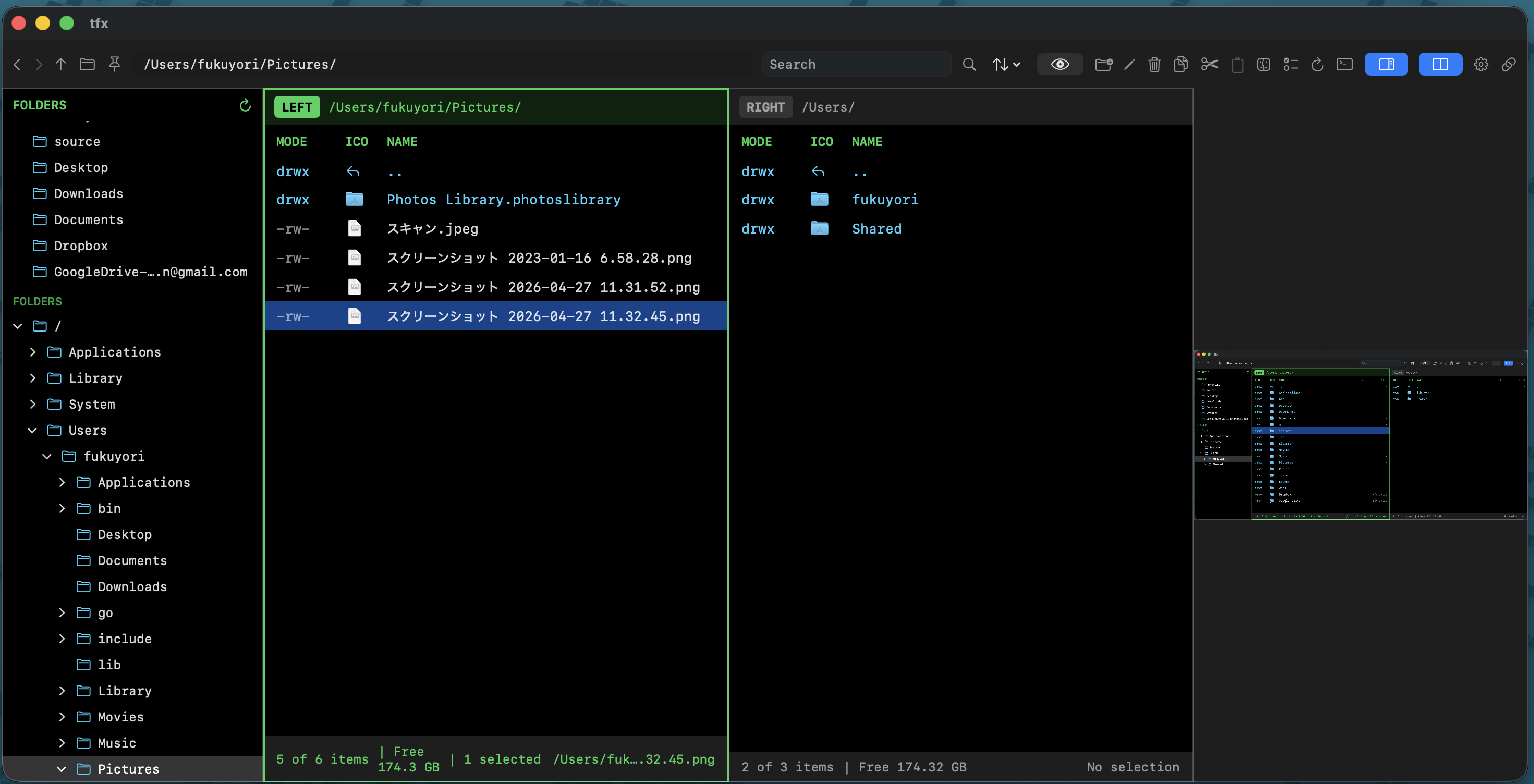
Two-pane file view in tfx for macOS
tfx / macOS
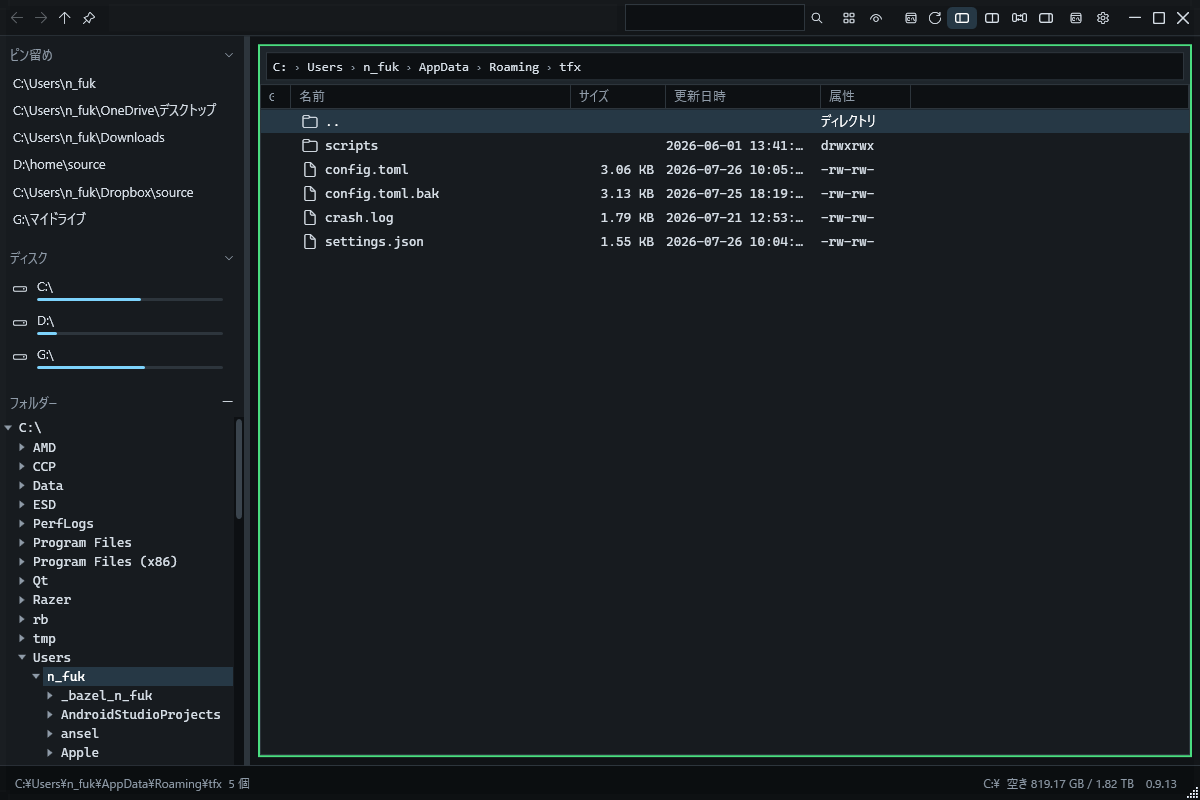
File list in tfx for Windows
tfx / Windows

01 / Why tfx

Bring the terminal workflow
into a visual interface.

Finder and Explorer are approachable, but terminal-trained hands often want one more step: move files between two panes, navigate without leaving the keyboard, and inspect Markdown or CSV without opening another app. tfx grew from those everyday points of friction.

The name stands for Terminal-inspired interface File eXplorer. Each edition uses native technologies to respect its operating system while sharing the same product philosophy and configuration structure.

The goal is not to turn a terminal into a GUI. It is to move naturally between command-line speed, the context of a visible file list, and the immediacy of drag and drop. Navigate with keys most of the time, then reach for the mouse when direct manipulation is clearer. tfx is for people who do not want to give up either way of working.

02 / Core features

Move, inspect, control.
Keep the flow going.

01

Two panes + folder tree

Switch between a single view and a split layout, with independent navigation in each pane. Keep the source and destination visible at the same time instead of arranging multiple windows. Drag between panes, browse from the root, and pin frequently used folders to shorten repeated trips.

02

Preview without opening

Inspect images, Markdown, HTML, CSV, TSV, and JSON beside the file list. Toggle rendered and source views, display structured data in readable form, summarize multiple selections, or browse a ZIP archive without extracting it. Fewer one-off app launches means fewer interruptions while deciding which file you need.

03

The file operations you expect

Create files and folders, rename in place, copy, cut, paste, move to trash, compress, and extract. Recursive searches run in the background, file watching reflects outside changes, and sorting, column layouts, multi-selection, and persistent view state support everyday organization.

04

Terminal and configuration nearby

Launch an external terminal with the current folder as its working directory, or open the integrated terminal beside the file list. A shared config.toml controls colors, fonts, shortcuts, startup layouts, file associations, and custom commands. Find a location visually, then continue there on the command line.
03 / In daily use

Finding a file should not
break the rest of the flow.

MOVE

When organizing

Open an inbox on the left and a project destination on the right to classify files without losing sight of where they will go. Because each pane has its own history, one location can stay anchored while the other moves through a deep hierarchy.

Select and drag several files with the mouse, or stay on the keyboard for copy and move operations. The interaction can match the volume and type of material in front of you.

INSPECT

When choosing content

Review similarly named images, Markdown notes, or CSV files simply by moving the selection, without opening and closing a separate application for every item. You keep the context of the directory while making a decision.

Read-only views of ZIP contents and multi-selection summaries also provide a safer first look before extracting or editing anything.

ACT

When moving to the next task

Once you find the right folder, open the integrated terminal there and run Git, build, or maintenance commands. Repeated operations can become custom commands available from the context menu.

The place where you find files and the place where you process them remain connected, reducing the need to copy a path and paste it into another window.

04 / Make it yours

Turn your workflow
into configuration.

Customize more than appearance: tune key bindings, external applications, and routine commands for your environment. macOS and Windows share the same basic configuration structure, so the same ideas carry across both systems.

For example, match the palette to your terminal, start with two panes and preview already visible, or send a file type to your preferred editor. Routine actions such as Git Pull or a project build can use {cwd} for the current folder and appear directly in a menu.

version = 1

[font]
mono = "monospace"
size = 13

[colors]
fileListBackground = "#020A12"
directoryForeground = "#66D9FF"

[[commands]]
name = "Git Pull"
run = "git -C {cwd} pull --ff-only"
terminal = true

05 / Choose your tfx

One idea,
native to each OS.

01Swift / SwiftUI

macOS

The original edition, built around Apple frameworks so file management feels at home on macOS.

  • PDFKit, AVKit, WebKit, and Quick Look previews
  • Folder tabs within each pane
  • Finder tags, aliases, and symbolic links
  • Launch from the command line with a starting folder
tfx for macOS ↗
02C# / WPF

Windows

A WPF translation of the macOS concept, shaped around Windows 10 and 11 shell conventions.

  • Integrated shell using WebView2, xterm.js, and ConPTY
  • Windows-style shortcuts, trash, and permanent deletion
  • Cached shell icons and thumbnails
  • A multi-stage PDF preview pipeline
tfx for Windows ↗
03C++ / Qt

Linux

A Qt edition that brings the tfx workflow to Linux while respecting the differences of its desktop environments.

  • Dockable panes arranged for the task
  • In-place previews of file content
  • An integrated terminal connected to the working folder
  • A native desktop UI built with C++ and Qt
tfx for Linux ↗

Stay in your flow

Make the next file move
a little shorter.

Choose a repository to find releases and installation details for your operating system.

Choose your tfx